

HOW IT WORKS
A New Architecture for Additive Manufacturing
Most 3D printing technologies were originally designed for prototyping. While they have improved significantly over the past decade, many systems still struggle to scale into true production environments. Throughput remains limited, material options are constrained, and increasing output often requires simply adding more machines.
Orange Maker (OM) approaches the problem differently.
Rather than adapting existing printer architectures, OM developed a fundamentally new platform for additive manufacturing built around rotation, modular print engines, and scalable system geometry. The result is a manufacturing platform designed to support larger build areas, higher throughput, and advanced materials while maintaining the precision expected from modern additive manufacturing.
The Limits of Conventional 3D Printing
Most additive manufacturing systems rely on a single print engine operating over a fixed build area. As production demand increases, these systems often encounter the same structural limitations.
Build volumes are constrained by machine size.
Throughput scales slowly as parts grow larger or more complex.
Printer farms increase operational complexity rather than true production efficiency.
Material options are often limited to resins or powders that fit the process constraints.
These limitations are not simply engineering challenges. They are architectural ones.
OM was designed to address these challenges at the system level.
A Different Manufacturing Platform
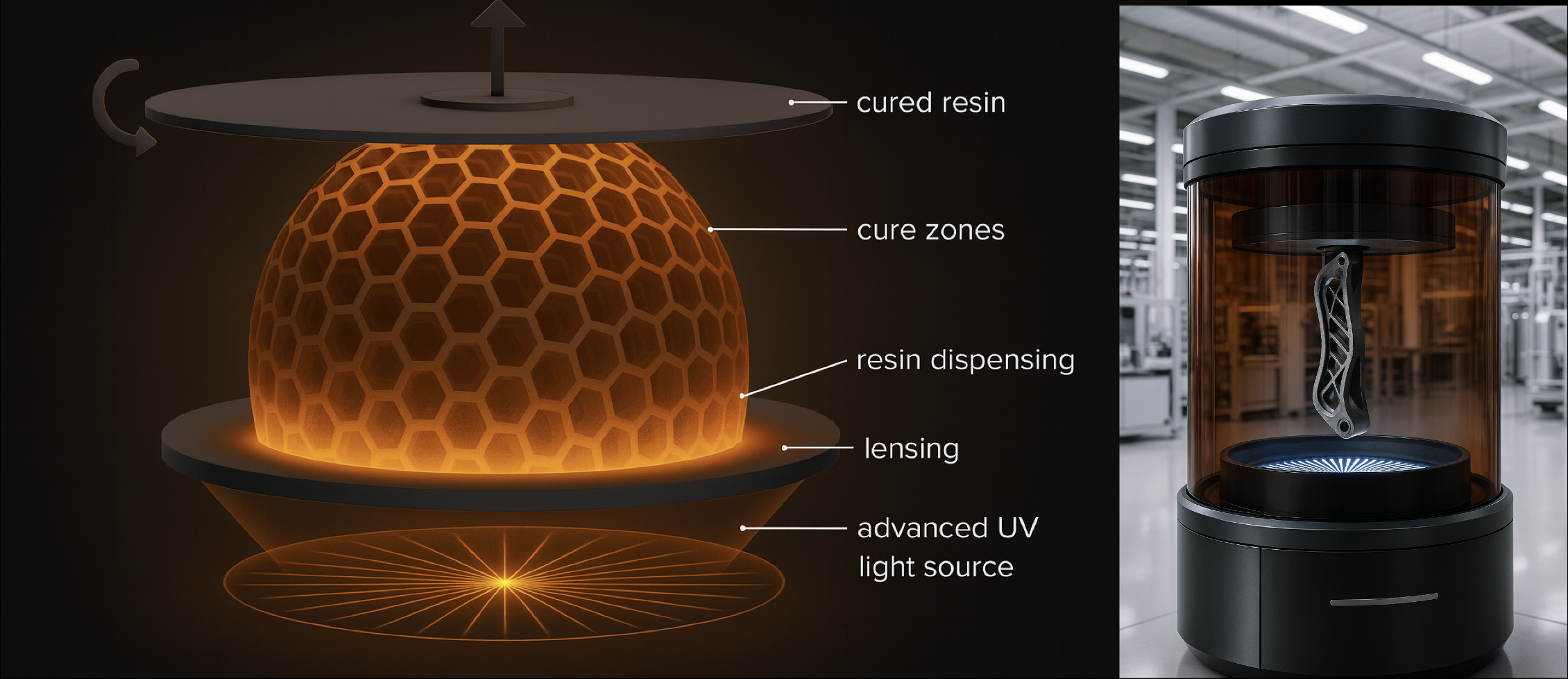
At the core of OM technology is a new manufacturing topology built around a rotating build architecture.
Instead of a single stationary print surface, OM systems use a rotating circular build plate that moves through a coordinated manufacturing process. Around this rotating build surface are modular conical belt print engines, each functioning as an independent production module.
Each module manages material handling, exposure, and separation as part of a coordinated system. The rotating build surface accumulates geometry as it passes through the process.
This architecture transforms the printer from a single machine into a scalable manufacturing platform.
The Core Process
OM’s process combines coordinated motion, modular print engines, and a shared build architecture to produce parts.
1. Independent print modules prepare each layer
Conical belt modules act as independent print engines. Each module manages its own material delivery, exposure, and separation process.
2. The build surface rotates through the system
A shared circular build plate moves continuously through the manufacturing zone, receiving cured geometry as it passes each module.
3. Geometry accumulates through coordinated motion
As the system rotates and each module contributes to the process, parts grow through a synchronized relationship between motion, exposure, and material handling.
4. Throughput scales through parallelization
Additional modules can be introduced to increase throughput, enable dedicated materials, or support different production configurations.
Why Rotation Matters
Rotation changes how additive manufacturing systems scale.
In conventional printers, increasing output often requires larger machines or more printers operating in parallel. OM’s architecture allows the system geometry itself to contribute to scalability.
As system diameter increases, the available build area expands significantly. This allows larger components, increased production capacity, and more efficient use of manufacturing space.
The result is a system architecture that can support industrial-scale additive manufacturing rather than simply extending prototype machines.
Modular Print Engines
OM systems are designed as configurable platforms.
Each conical belt module functions as a dedicated print engine within the system. Modules can be configured, added, or specialized depending on the manufacturing application.
This modular architecture enables:
Parallel throughput scaling through additional modules
Dedicated material channels for specialized processes
Flexible system configurations for different industries
Adaptable manufacturing systems that evolve with production needs
Rather than a fixed machine design, OM technology functions as a platform capable of supporting many manufacturing environments.
Advanced Materials
Material capability is one of the most important factors in industrial additive manufacturing.
Many conventional systems struggle with high-viscosity materials, filled composites, or specialized formulations required for functional parts.
OM’s architecture is designed to support a wider range of materials, including systems that may benefit from:
Highly filled composite resins
Industrial tooling materials
Elastomeric systems
Specialized engineering polymers
Multi-material manufacturing processes
This opens the door to stronger, more functional end-use components across multiple industries.
Multi-Material Manufacturing
Because OM systems use independent print modules, different materials can potentially be assigned to different modules within the platform.
This creates a pathway toward multi-material part production where different materials, properties, or functions can be integrated within the same manufacturing process.
Instead of forcing multiple materials through a single process channel, OM’s architecture allows each material system to be optimized within its own module.
This capability has long-term implications for applications such as dental manufacturing, elastomer-rigid hybrid parts, orthotics, and advanced functional assemblies.
From Prototype to Production
Additive manufacturing has transformed product development over the past decade. However, scaling these technologies into full production environments remains one of the industry's largest challenges.
OM’s platform was designed specifically with production in mind.
By combining rotational architecture, modular print engines, and scalable system geometry, OM technology aims to bridge the gap between prototype machines and true manufacturing systems.
The platform supports larger components, higher throughput, and greater process flexibility while maintaining the precision that additive manufacturing is known for.
A New Field of Additive Manufacturing
OM’s approach represents more than a new machine. It introduces a new architecture for additive manufacturing.
By rethinking the relationship between motion, geometry, and production modules, the platform expands what additive manufacturing systems can achieve in terms of scale, throughput, and material capability.
As the field continues to evolve, architectures like OM’s have the potential to reshape how additive manufacturing is deployed across industries ranging from industrial tooling and dental manufacturing to advanced composites, aerospace components, and future multi-material products.
Together, these elements form the foundation of OM’s scalable additive manufacturing platform.
Technology Notice
The information presented on this page is intended to provide a general overview of OM’s additive manufacturing platform and system architecture. Certain technical details have been simplified for a web audience. More detailed technical information, specifications, and documentation can be made available to qualified partners, collaborators, and interested parties upon request. Contact Us.